
NW Minnesota Soil & Water Quality Learning Exchange
Mar 25, 2026 8:30AM—5:00PM
Location
Seven Clans Casino - 20595 Center St E Thief River Falls, MN 56701
Cost $25-$35
Event Contact Jonathan Kilpatrick | Email
Categories Conference, General Networking & Education
Topics Conservation, General, grazing, Livestock, Soil Health
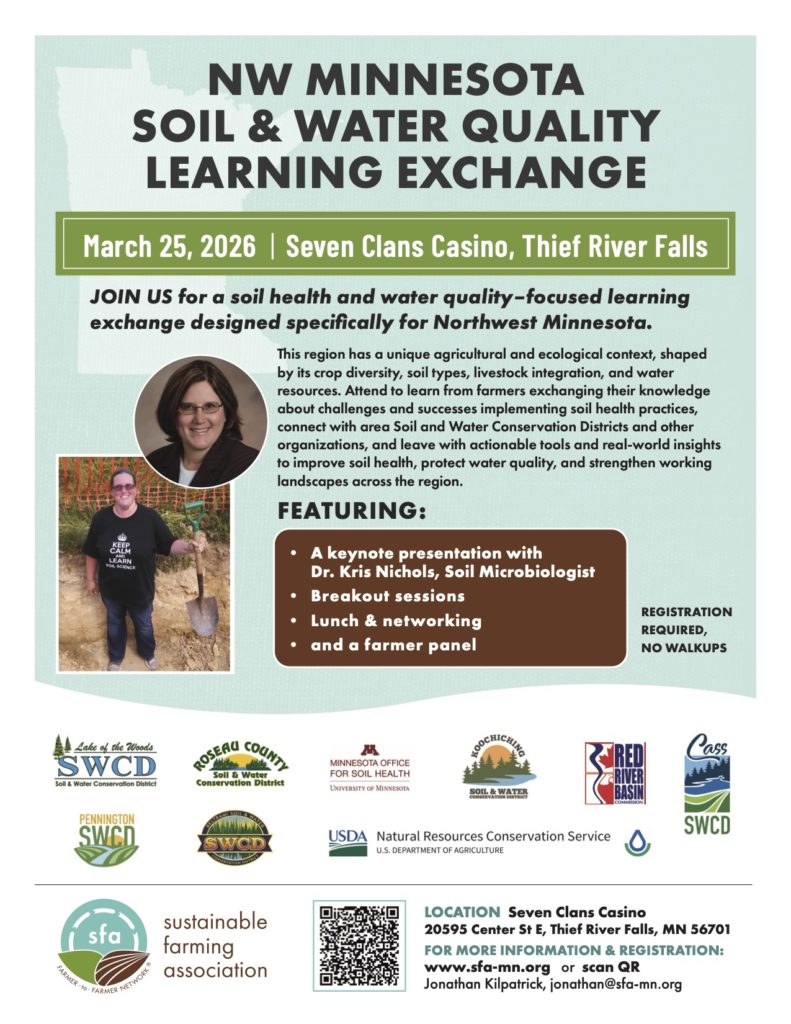
The Sustainable Farming Association, in partnership with Lake of the Woods and Roseau County SWCDs, is launching a soil health & water quality focused learning exchange in Northwest Minnesota. While many similar events are held in central and southern parts of the state, distance can be a barrier to participation for our northern farmers and ranchers. This region has unique opportunities: greater crop diversity, lower land values, and more livestock—all opportunities that create a unique context. Together with local SWCDs and partner organizations, we aim to host a valuable, one-day learning exchange that equips farmers and communities with practical tools to improve soil, protect water, and strengthen ecosystems. Join us in making this inaugural gathering a success!
Schedule Overview
8 AM Registration and networking with coffee and light breakfast
9 AM Welcome
9:15 AM “Regenerating Soil First Farming” with Dr. Kris Nichols
10:30-11 AM Break & Networking
11-12:15 Breakout Sessions
12:15-1:15 PM Lunch
1:15-2:15 PM Breakout sessions
2:15-2:45 PM Break & Networking
2:45-3:45 PM “Regenerating Soil to Regenerate Water Quality” with Dr. Kris Nichols
3:45-4 PM Break & Networking
4-4:45 PM “How to Apply What You Heard Today” Farmer Panel moderated by Kim Melton, Red River Basin Commission
4:45-5 PM Final words and wrap-up
Registration
Advance registration required, no walkups. Lunch, coffee, and light breakfast provided. SFA members can register for $25, nonmembers for $35. Members must log in to see member pricing. Learn more about joining SFA here.
Location
Please note the location change! Seven Clans Casino – 20595 Center St E Thief River Falls, MN 56701
Keynote Speaker
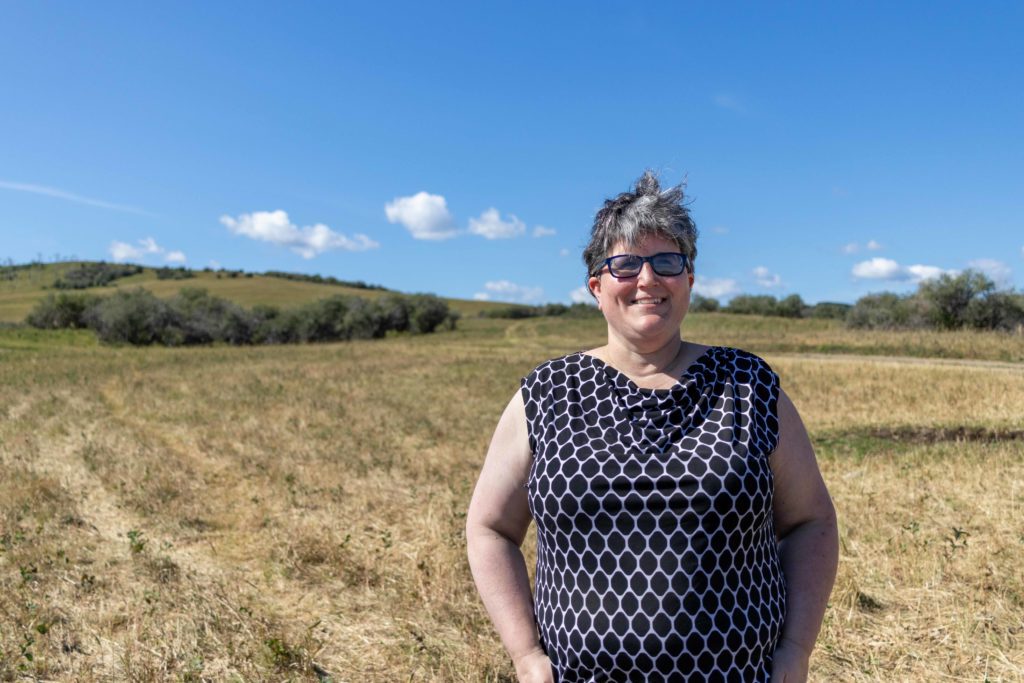
Dr. Kris Nichols is the founder and principal scientist of KRIS (Knowledge for Regeneration and Innovation in Soils) Systems. Kris is a research consultant with Food Water Wellness Foundation in Olds, Alberta and MyLand Company Inc. in Phoenix, Arizona. She has worked for Canadian Organic Growers, the Rodale Institute, and USDA-Agricultural Research Service. Kris advisor to the Real Organic Project; Savory Institute’s – Ecological Outcome Verification program, McCain’s Farms of the Future; and Health First. She has Bachelor of Science degrees in Plant Biology and Genetics and Cell Biology, a Master’s degree in Environmental Microbiology, and a Ph.D. in Soil Science. Kris has given over 300 invited presentations throughout the world; authored or co-authored more than 30 peer-reviewed publications; and been cited or interviewed for more than 100 magazine or newspaper articles, multiple books, numerous podcast and online videos, and three documentaries.
Dr. Nichols will be leading two sessions:
- Regenerating Soil First Farming (9:15 AM) Healthy soil is not the starting point—it’s the result. In regenerative agriculture, soil health is built through intentional management that increases organic matter and supports the biological, chemical, and physical functions of soil. This session explores a soil-first farming mindset and walks through the opportunities created by applying the six soil health principles, with practical examples of how these principles can expand management options on working farms.
- Regenerating Soil to Regenerate Water Quality (2:45 PM) Water quality is shaped long before runoff reaches a ditch, stream, or well—it’s determined by how water moves through soil. Regenerating soil increases organic matter, particularly carbon, which plays a critical role in water infiltration, storage, and filtration. Carbon-rich soils bind nutrients and contaminants, reducing nutrient loss, protecting groundwater, and improving surface water quality.
Much like carbon filters used in industrial air and water purification systems, healthy soils act as living filters. By applying regenerative soil management principles, farmers can improve water holding capacity, reduce runoff and leaching, and keep nutrients where crops and forages can use them. This session explores how regenerating soil biology and organic matter directly translates into cleaner water, more resilient fields, and improved downstream outcomes.
11:00 AM Breakout Sessions
- Cattle Feeding Practices for Soil Health and Smart Ranching Finding ways to reduce feed costs each winter and avoid hauling manure each spring is easier than you think! By incorporating cover crops and bale grazing you feed your livestock and the biology in your soil, all while saving money. Sabrina Claeys and Kent Solberg will walk you through the technical details of cover crops and bale grazing. Hear from Cole Christianson about his personal experience incorporating these soil health practices into his cow calf operation just outside of Greenbush.
Presented by Sabrina Claeys, Grazing Specialist, Ducks Unlimited
Kent Solberg, Regenerative Ag Advisor, SFA
Cole Christianson, Cow/calf operator, Greenbush, MN
- Cereal Rye Strips with Sugar Beets and Cover Crops for Cyst Nematode Jeremy Tischer and Ken Packer share on-farm experience managing sugar beet cyst nematodes across diverse soil types in Wilkin County. Jeremy discusses using cereal rye strips to reduce stand loss in emerging sugar beets, along with reduced tillage and variable-rate nutrient management. Ken shares his transition from conventional tillage to no-till and how cover crops have helped suppress cyst nematode populations while improving overall soil health. This session highlights practical strategies and lessons learned from real-world implementation.
Jeremy Tischer is a farmer in Wilkin County. His crop rotation consists of wheat, sugar beets, corn, and soybeans. He has been farming in a wide range of soil types, from clay loam to Wyndmere sandy loam, for over two decades taking over his operation from his dad and his uncle. Jeremy has been experimenting with cereal rye as strips in his fields to decrease stand loss on his young, emerged sugar beets. He has also been experimenting with reduced tillage and incorporates variable rate application nutrient management across his operation.
Ken Packer is a farmer on the north end of Wilkin County where the soil is a sandy loam to a clay loam. Ken has been farming for 30 years transitioning the farm from his dad’s conventional tillage practices to his no-till, reduced tillage over the past five years. A challenge he noticed early on in his farming career was an increase in cyst nematodes. He has found utilizing cover crops to be a way to decrease those population numbers while retaining other soil health benefits. Ken will share his knowledge of cover crop use and how he applies this to his farm operation.
1:15 PM Breakout Sessions
- Implementing all the Soil Health Principles on a Grain Operation with Ryan Hough
- How Precision Profitability Mapping Can Improve Your Profitability in 2026 with Anthony Bly and David Kruger. Every Acre Counts is a precision profitability initiative helping farmers identify marginal acres that reduce whole‑field performance. By analyzing multi‑year yield data, costs, and ROI, the program highlights wet, eroded, or saline areas where converting cropland to grass or perennials can improve profits, sustainability, water quality, and soil health. Real‑world examples show increased yields, lower expenses, and higher ROI after removing unproductive acres. The program supports conservation enrollment and strengthens long‑term agricultural resilience across participating farms.
Anthony Bly is currently a Soils Field Specialist with SDSU Extension. He works with crop producers and agronomists to solve soil issues through educational activities developed from unbiased soil and crop research. Anthony’s knowledge areas include soil fertility, testing, and health factors related to resource management and crop productivity. Previously, Anthony was employed by the SDSU Plant Science Department as a Research and Extension Associate from 1992 to 2011. Between 2011 and 2013, Anthony provided technical expertise to launch a soil testing lab located in Sioux Falls, SD (AgLab Express). Anthony holds a BS (88) and MS (92) degrees in Agronomy from SDSU. Anthony is thankful for the many influential mentors he has worked with at SDSU and tries to exemplify their teachings and examples in his work and life.
David Kruger farms on the eastern slope of the Couteau Hills in northeast South Dakota. He began experimenting with notill practices in 1993. Over the past 33 years, he has tried a wide range of approaches—including striptill, cover crops, diverse crop rotations (spring wheat, winter wheat, Kernza, camelina, rye, corn, and soybeans), and adjusted fertilizer rates—always looking for ways to reduce inputs, maintain yields, and ultimately increase profitability. David recognizes that every farm is different. What works on his operation may not work exactly the same on yours. However, he hopes that by sharing his experiences, you might find ideas that help you make positive, profitable changes on your own farm.”
Event Partners
Thank you to our many partners for making this event possible: Beltrami SWCD, Cass SWCD, Koochiching SWCD, Lake of the Woods SWCD, Pennington SWCD, Red River Basin Commission, and Roseau County SWCD.
SFA staff and volunteers occasionally take photos during our workshops, cafe chats and field days for promotional purposes and to use as documentation of events to share with our funders. If you do not wish to be photographed, please let our event host know — we’ll make every effort to make sure you are not photographed.